What's in this guide
- Why epoxy adhesive selection determines assembly reliability
- Core selection criteria: five questions buyers must answer
- Two-part epoxy vs one-part sealant: which fits your application
- Real product specifications compared
- Application scenarios and matching adhesive chemistry
- Supplier evaluation checklist beyond the data sheet
- Common sourcing mistakes and how to prevent them
- Frequently asked questions
Why epoxy adhesive selection determines assembly reliability
If you are sourcing industrial adhesives for a production line, the data sheet is only the starting point. A structural epoxy that hits 20 MPa tensile shear on steel in a lab may still fail in your assembly if the pot life is too short for your cycle time, or if the cure schedule does not match your oven capacity. Buyers who treat adhesive selection as a line-item commodity rather than an engineering decision end up with rework, field failures, and delayed product launches.
This guide walks through the selection criteria that matter for B2B procurement — mix ratio tolerance, cure kinetics, substrate compatibility, compliance documentation, and supplier process control — using verified specifications from real adhesive products. The goal is to help you evaluate suppliers on facts, not marketing language.
01 — Define the bond
Substrates, joint geometry, load direction, and environmental exposure determine the chemistry family before any supplier conversation begins.
02 — Match cure to process
Pot life, handling time, and full-cure schedule must align with your takt time, oven capacity, and workforce flow on the assembly floor.
03 — Verify compliance
RoHS, REACH, and ISO 9001 documentation should be available before sample evaluation — not promised after the PO is placed.
04 — Validate in production
Lab lap-shear data does not predict line performance. Run a pilot batch under your actual conditions and test destructively.
Core selection criteria: five questions buyers must answer
Before requesting samples from any adhesive supplier, answer these five questions in writing. If you cannot answer one of them, that is the question most likely to cause a sourcing failure downstream.
- What substrates are being bonded, and what surface preparation is feasible?
Mirror-finish steel, anodized aluminum, glass-reinforced composites, and seasoned wood each require different adhesion strategies. If your line cannot do plasma treatment or primer application, the adhesive chemistry must compensate — typically through a formulation designed for unprimed adhesion.
- What is the maximum temperature the bond line will see in service?
A standard epoxy rated for 80°C continuous exposure will degrade rapidly if the assembly operates near engines, heat sinks, or reflow ovens. High-temperature epoxies rated for 200°C exist, but they trade flexibility and cure speed for thermal resistance. Know the number before you specify.
- How much working time does your operators need?
A 25-minute pot life sounds generous until you have a 20-minute dispensing cycle and a 10-minute assembly step. Pot life is not a suggestion — it is the window after which viscosity rises and bond quality drops. Factor in ambient temperature: pot life at 30°C can be half of what the data sheet lists at 23°C.
- What mechanical loads will the joint experience — static, dynamic, or impact?
Standard rigid epoxies carry high static shear loads but crack under impact or vibration. If your assembly sees drop shock, thermal cycling, or mechanical vibration, a toughened or flexible epoxy formulation will outperform a higher-strength but brittle alternative.
- Which regulatory frameworks must the finished product comply with?
RoHS and REACH compliance is standard for electronics and automotive, but specific applications may also require UL 94V-0 flame retardancy, USP Class VI biocompatibility, or MIL-STD qualification. Confirm that the adhesive supplier's compliance documentation covers your target markets — not just generic "compliant" claims.
Two-part epoxy vs one-part sealant: which fits your application
The choice between a two-part structural epoxy and a one-part moisture-curing sealant is not about which is "better" — it is about which matches your assembly process and performance requirements. The comparison below uses verified specifications from two real products in our line to illustrate the trade-offs.
| Decision factor | Two-part epoxy structural adhesive | One-part polyurethane joint sealant |
|---|---|---|
| Primary function | Load-bearing structural bond between metal, composite, or wood substrates | Flexible sealing of construction joints, curtain walls, and equipment interfaces |
| Cure mechanism | 1:1 mix ratio, chemical crosslinking at room temperature | Moisture cure from ambient humidity — no mixing required |
| Handling strength | 4 hours; full cure in 24 hours | Skin forms in 2–4 hours; full cure at approximately 2 mm depth per week |
| Key mechanical metric | 20+ MPa tensile shear strength on steel | 200%+ elongation at break; ±20% movement capability |
| Substrate adhesion | Metals, composites, wood — no primer needed | Concrete, glass, metal — no primer needed |
| Best suited for | Rigid assemblies where joint strength is the priority | Joints that expand, contract, or vibrate over service life |
| Compliance | ISO 9001 certified manufacturing | EN 14189 and ASTM C920 compliant; low VOC |
The pattern is clear: choose a two-part epoxy when the joint must hold a fixed load and resist shear, and choose a one-part polyurethane when the joint must flex and seal without cracking. Some assemblies need both — a structural epoxy for the primary bond and a sealant for environmental protection — and sourcing both from the same supplier simplifies traceability and quality management.
Real product specifications compared
Below are the verified specifications for two adhesive products from our Tianjin manufacturing line. These numbers come from internal quality testing and are the same values reported on product data sheets shipped with every order.
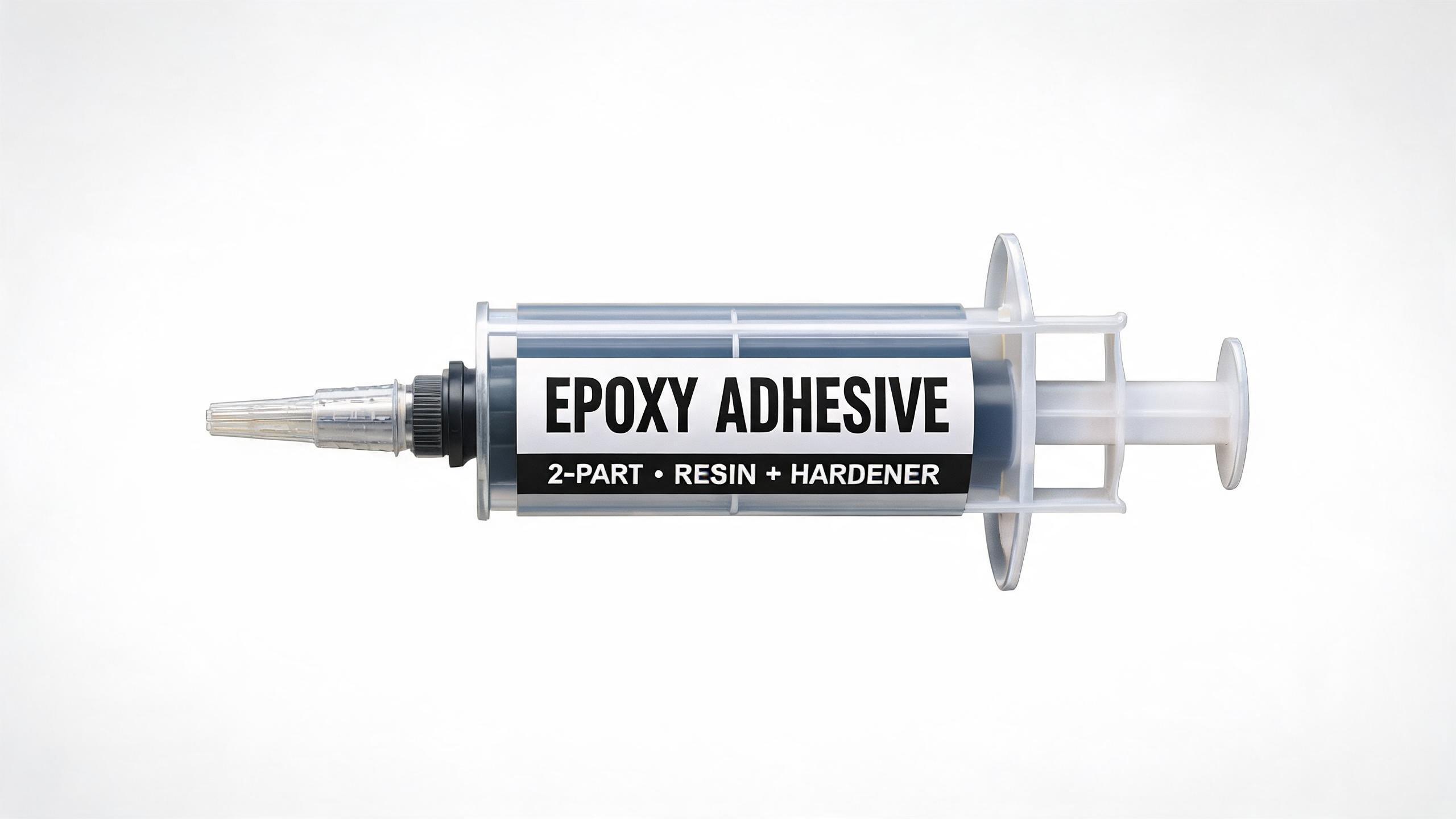
Two-part epoxy structural adhesive
| Mix ratio | 1:1 by weight |
|---|---|
| Pot life | 25 minutes at 23°C |
| Tensile shear strength | 20 MPa on steel |
| Handling strength | 4 hours |
| Full cure time | 24 hours |
| Appearance | Clear amber |
| VOC profile | Low VOC formulation |
| Substrates without primer | Metals, composites, wood |
| Quality certification | ISO 9001 certified |
One-component polyurethane joint sealant
| Cure type | Moisture-curing, single component |
|---|---|
| Skin formation | 2–4 hours |
| Elongation at break | 200%+ |
| Movement capability | ±20% of joint width |
| Cure rate | 2 mm per week depth |
| Substrates without primer | Concrete, glass, metal |
| Compliance standards | EN 14189, ASTM C920 |
| VOC profile | Low VOC — indoor air quality safe |
Application scenarios and matching adhesive chemistry
Different industries impose different demands on adhesive joints. The examples below map common application scenarios to the adhesive chemistry that typically performs best, based on field experience and product specifications.
Electronics assembly and PCB protection
Printed circuit boards need adhesives and coatings that comply with RoHS and REACH, withstand reflow soldering temperatures, and do not outgas corrosive volatiles. Conformal coatings protect against moisture and contamination, while thermally conductive adhesives transfer heat from power components to heat sinks. For conformal coating applications, an acrylic conformal coating provides a balance of moisture resistance, repairability, and compliance documentation. For thermal management, a silicone thermal grease rated at 3 W/mK or a thermally conductive silicone adhesive can bridge the gap between heat-generating components and散热 surfaces while maintaining electrical isolation.
Structural assembly and composite bonding
When bonding metal brackets to composite panels or assembling wood-based structural elements, a two-part epoxy with 20 MPa shear strength on steel provides the load-carrying capacity needed for durable assemblies. The two-part epoxy structural adhesive listed above handles this category. For assemblies that experience impact or flexural stress — such as equipment housings or vibration-exposed mounts — a toughened flexible epoxy absorbs energy that would crack a rigid formulation.
Construction joints and facade sealing
Building facades, curtain walls, and expansion joints require sealants that accommodate movement without losing adhesion. The one-part polyurethane sealant above — with ±20% movement capability and adhesion to concrete, glass, and metal without primer — is engineered for this category. Its EN 14189 and ASTM C920 compliance provides the documentation needed for architectural project approvals.
High-temperature service environments
Adhesive joints near engines, industrial ovens, or continuously loaded power electronics need formulations that retain strength above 150°C. Standard epoxies soften and creep at these temperatures. A high-temperature epoxy rated for 200°C maintains structural integrity where general-purpose adhesives fail. Confirm the temperature rating against your actual service condition, not the peak excursion — continuous exposure and peak exposure impose different degradation mechanisms.
Supplier evaluation checklist beyond the data sheet
A data sheet tells you what a product did in a supplier's lab. It does not tell you whether that supplier can deliver the same product consistently, in your volume, with the documentation your customer requires. Use the following checklist to evaluate adhesive suppliers before committing to a production order.
Quality management certification confirms process control is documented and audited — not just claimed. Our Tianjin facility operates under ISO 9001:2015, covering every stage from raw material inspection through final packaging. Certificates are available on request before you place an order.
Viscosity meters, tensile strength testers, and environmental chambers allow batch-level validation. Ask whether the supplier tests every batch or only periodically — the answer affects lot traceability and your ability to isolate failures.
Compliance documents should name the specific product and revision date, not reference a generic "compliant" claim. If a supplier cannot produce a product-specific RoHS declaration, that is a procurement risk regardless of how the adhesive performs.
Request retention sample data from the last three production batches. Viscosity, color, and cure-time variation outside specification ranges indicates process drift that will eventually reach your assembly line.
Bulk orders in IBC containers, drums, or custom packaging require warehousing and logistics infrastructure. Confirm that the supplier can handle your volume and packaging format before you build a production schedule around their delivery commitments.
Common sourcing mistakes and how to prevent them
Most adhesive sourcing failures share a small number of root causes. The accordion below covers the mistakes encountered most frequently in B2B procurement, with specific prevention steps for each.
Specifying strength without checking pot life against cycle time
A buyer selects an adhesive based on 25 MPa shear strength, but the 25-minute pot life at 23°C leaves insufficient time for a 20-minute dispensing and assembly step — especially when ambient temperature on the factory floor reaches 28°C, which shortens pot life by 30–40%. Prevention: calculate the required working time from your actual cycle, then add a 30% safety margin before selecting an adhesive. If the data sheet pot life at 23°C does not cover your margin after temperature derating, choose a slower-curing formulation or implement temperature-controlled dispensing.
Assuming "universal adhesion" means adhesion without surface preparation
Data sheets that list "bonds metals, composites, and wood without primer" are reporting lab results on cleaned, dry substrates. In production, surfaces carry machining oils, oxide layers, mold release agents, or atmospheric moisture. Prevention: define your surface preparation standard (solvent wipe, abrasion, plasma treatment) in the procurement specification, and validate adhesion on substrates prepared exactly as your line prepares them — not on lab-prepared coupons.
Overlooking cure schedule and oven capacity
Full cure in 24 hours at room temperature sounds convenient, but if your production throughput requires parts to move to the next station in 2 hours, the 4-hour handling-strength window is still a bottleneck. Some epoxies accelerate cure with heat — confirm whether your facility has oven capacity for a 60–80°C acceleration step, and whether the adhesive formulation supports it without exothermic reaction risk.
Accepting generic compliance claims without product-specific documentation
"RoHS compliant" on a website is not documentation. A supplier should provide a product-specific RoHS declaration naming the product code, revision date, and the restricted substances tested. The same applies to REACH SVHC declarations. Prevention: request compliance documents during supplier evaluation, not after the PO — and verify that the documents reference the correct product revision.
Frequently asked questions
What mix ratio does the two-part epoxy use, and how precisely must it be measured?
The two-part epoxy structural adhesive uses a 1:1 mix ratio by weight. For structural applications, mix ratio accuracy within ±2% is recommended to ensure full crosslinking and achieve the rated 20 MPa tensile shear strength. Meter-mix dispensing equipment is preferable to manual mixing for production volumes. Significant over- or under-dosing of either component will result in incomplete cure and reduced mechanical properties.
Can the polyurethane sealant be applied in cold or humid weather?
The one-part polyurethane joint sealant cures by reacting with ambient moisture. Low temperatures (below 5°C) slow the cure rate significantly, and very low humidity can extend skin formation beyond the 2–4 hour window. Conversely, very high humidity may cause bubbling if the skin forms faster than entrapped air escapes. For cold-weather application, consult the supplier for accelerator options and adjusted cure-time expectations.
Are RoHS and REACH compliance documents available before placing an order?
Yes. Product-specific RoHS declarations and REACH SVHC statements are available on request. We recommend requesting compliance documentation during supplier evaluation so that your quality team can verify the product revision and restricted-substance scope before sample evaluation begins.
What is the minimum order quantity, and can packaging be customized?
MOQ and packaging options — including IBC containers, drums, cartridges, and custom formats — depend on the specific product and your project volume. Please share your estimated annual quantity, preferred packaging format, and destination port so we can confirm availability and pricing for your requirements.
How are adhesive batches traceable, and what retention samples are kept?
Under our ISO 9001:2015 quality management system, every production batch receives a unique lot number recorded in the manufacturing record. Retention samples are stored for the period defined by the product's quality plan. Batch-specific test reports — including viscosity, cure time, and tensile shear data — are available on request and accompany bulk shipments when specified in the purchase order.
Next steps: send your application details for a tailored recommendation
Selecting the right adhesive is an engineering decision, not a commodity purchase. If you share the substrates, service temperature, joint geometry, regulatory requirements, and estimated annual volume, our technical team can recommend the chemistry and product that fits your assembly process — and flag any compatibility risks before you invest in sample evaluation.
Move your project forward.
Send the application details for review — substrates, service conditions, target volume, and compliance requirements.